A more environmentally enlightened consumer
2023 · Bergen · 2 min read
Team Benjamin Late, Remi André Nygård and Ole Sander Brudvik
You can read more about Way To Go here. Test the prototype here!
- Problem
- Consumers cannot see a product’s value chain or climate impact at the moment they are deciding whether to buy it.
- Approach
- Research into the UN sustainability goals and the circular economy, low-fidelity prototyping, and an interactive Figma prototype.
- Outcome
- A scan-first app: recognise a product or scan a QR code, then see its impact, greener alternatives, and your own consumption over time.
What if you could see a product’s whole journey — and its climate cost — before you bought it? Way To Go is a scan-first app that shows you exactly that.
Gen Z wants a Shazam for shopping
- Young adults — Gen Z and millennials — moderately to very conscious about the environment.
- At the shelf: no way to tell green from not-so-green, no idea where a product has been.
- A workshop with eight groups of one to five: group discussion and individual views, both.
- The brief: scanning within reach, a start page like Shazam’s, a clean app with several features.
Prototype
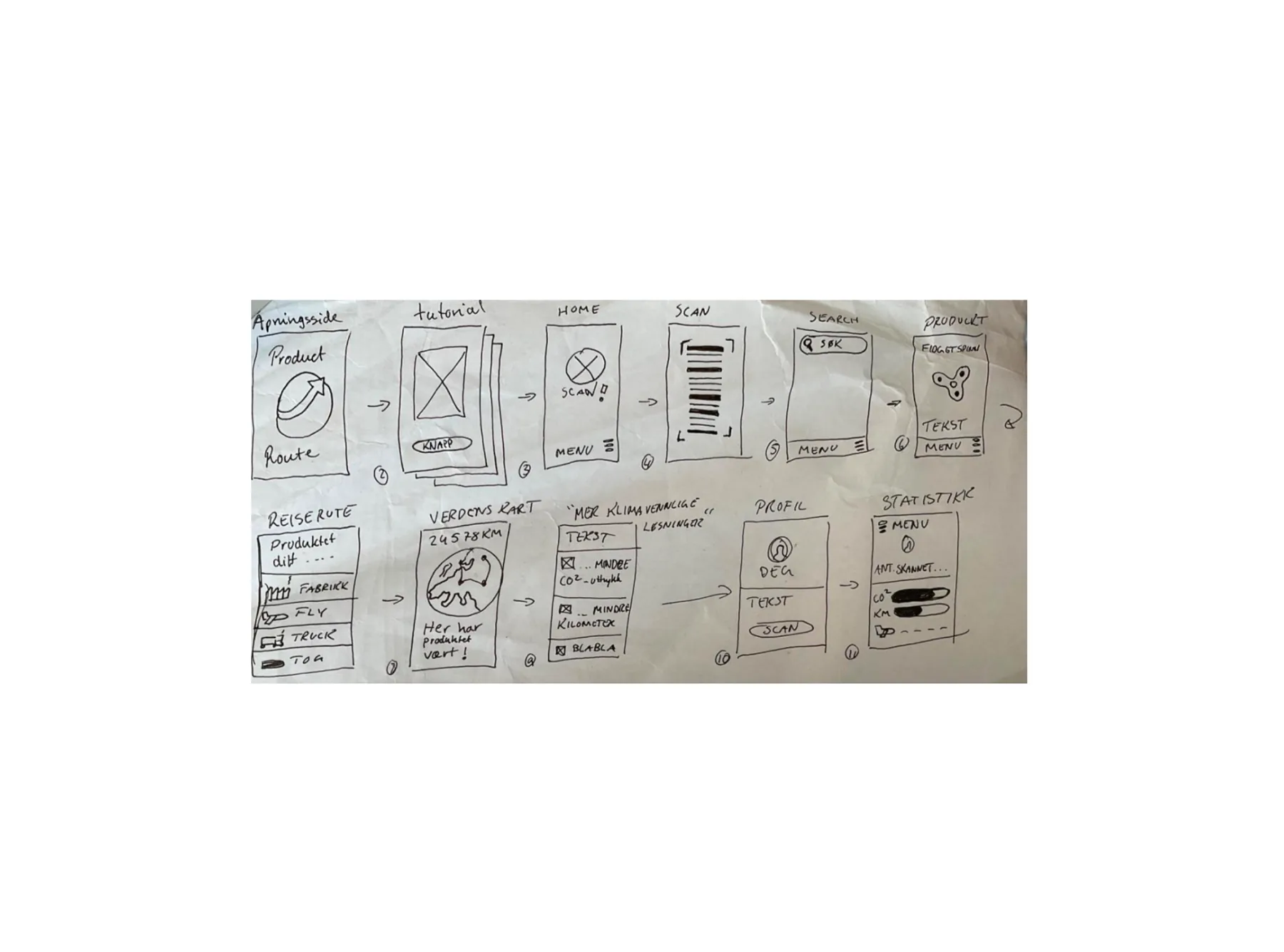
Low-fidelity on paper first, then the Figma prototype: one green button, the scanner, the three options.
Nothing new here, except all of it
Every piece exists somewhere. Vipps scans bills, plenty of apps scan QR codes, statistics and social layers are everywhere, and Oda shows the climate footprint of food — for what you buy from Oda. Put together, though, the combination has no direct equivalent: image recognition plus logistics data to show consumption and travel distance, born out of a strong grasp of logistics.
Shazam was the closest cousin, so we borrowed what it has surely tested — the placement of that first big button, a few menu elements — and changed everything else, because the purpose is nothing alike. Which is one more reason the workshop earned its keep. The full report is linked at the top.
Scan, then see
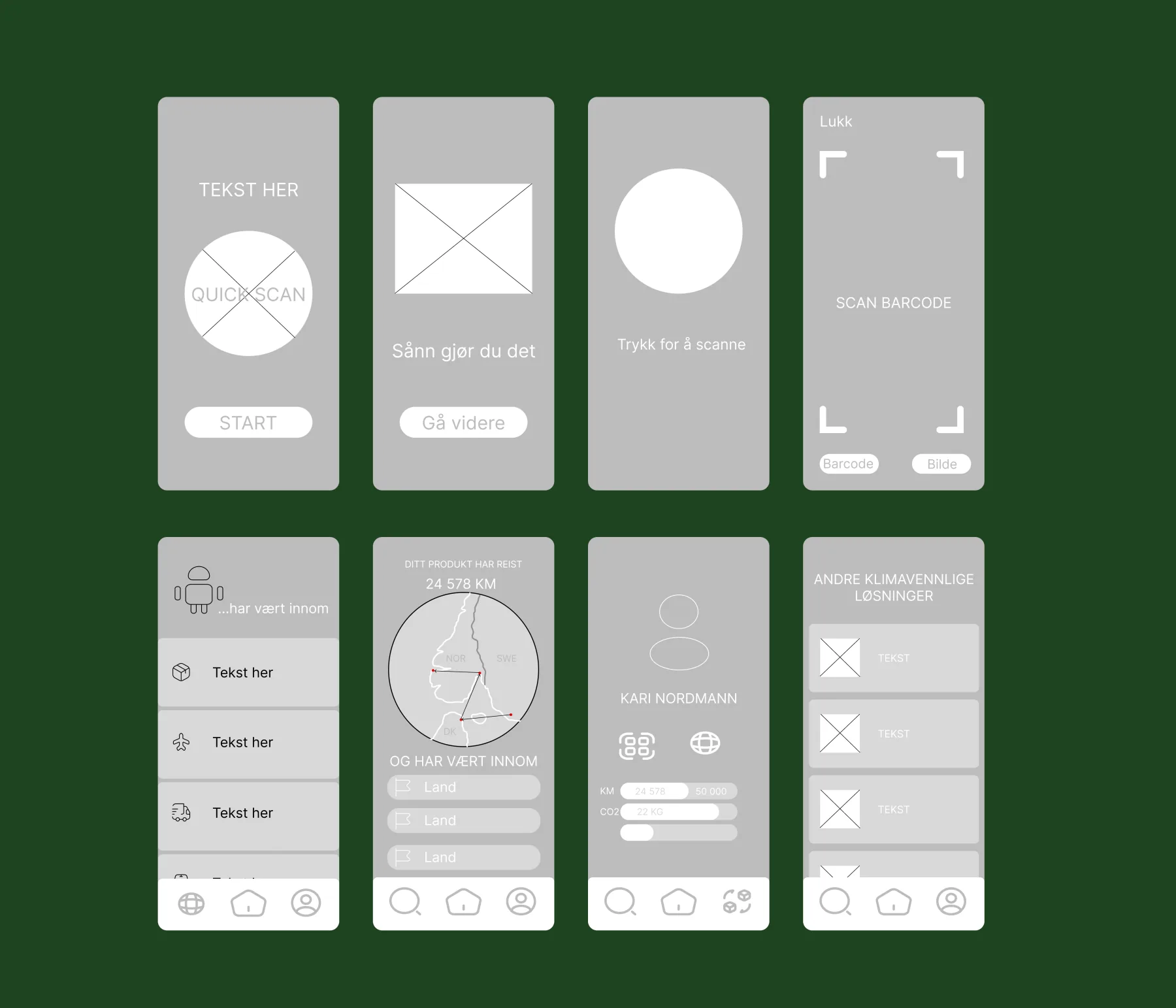
Open the app and there is one green button: start. It takes you straight to the point — recognise a product or scan its QR code — and the product comes up with three options, and a rescan if it guessed wrong.
- Its journey. Where the product has been and what it cost the climate, with the option to register it.
- Register it. Into your library, footprint included.
- Greener alternatives. Including local ones: the green pins on the map came straight out of the workshop.
“Stats” shows your consumption by month and year and your greenest product; “CO2 compensation” lets you support organisations that protect wildlife and the environment with points or money.
Get in toucholebrudvikjr@hotmail.com