
Co-design platform for educational games
2025 · Bergen · 2 min read
Team Hallvard Lygre Hetlelid, Remi André Nygård, Silje Garmannslund Eide & Ole Sander Brudvik
Fredrik Breien's eLuna research Read more about the final solution Bachelor project report Test the prototype (Figma)
- Problem
- Educational games lean too hard on curriculum and lose engagement, or chase fun and teach little. Meanwhile the Ministry of Education’s ambitions for digital practice stayed theoretical.
- Approach
- A co-design workshop led by eLuna’s creator, 18 qualitative interviews, Crazy 8’s, storyboarding and wireframing, then both a Figma and a coded prototype.
- Outcome
- A platform with two creation pathways — fully digital, or pen & paper first — so teachers can run a workshop before formalising ideas. Tested with teacher students, information science students and SLATE.
A platform where teachers, developers and researchers design educational games together — built for SLATE, the Norwegian Centre for the Science of Learning & Technology, as my bachelor project.
The gap between policy and classroom
The Ministry of Education wants digital practice in schools to be knowledge-based, to support learning and motivation, and to be woven into the school’s own plans — not bolted on. Fine words. SLATE wanted something a teacher could use on a Tuesday. Nova Luna Studio is our answer: a platform where teachers, developers and researchers design educational games together.
The pain is an old one. Educational games either lean so hard on the curriculum that nobody wants to play, or chase fun and teach nothing — too hard for the students who struggle, too easy for the ones who fly.
Eighteen interviews and a workshop
Fredrik Breien — the customer, and the creator of the eLuna framework — led our co-design workshop. Around it: observation, and 18 qualitative interviews with teachers, a researcher, a pedagogue and a developer.
18 qualitative interviews: 15 teachers, a researcher, a pedagogue and a developer.
Sketch, test, repeat
- No grand reveal: refined continuously as interviews and tests came in, Toyota-style.
- Crazy 8’s — eight ideas in eight minutes, each — so nobody married the first one.
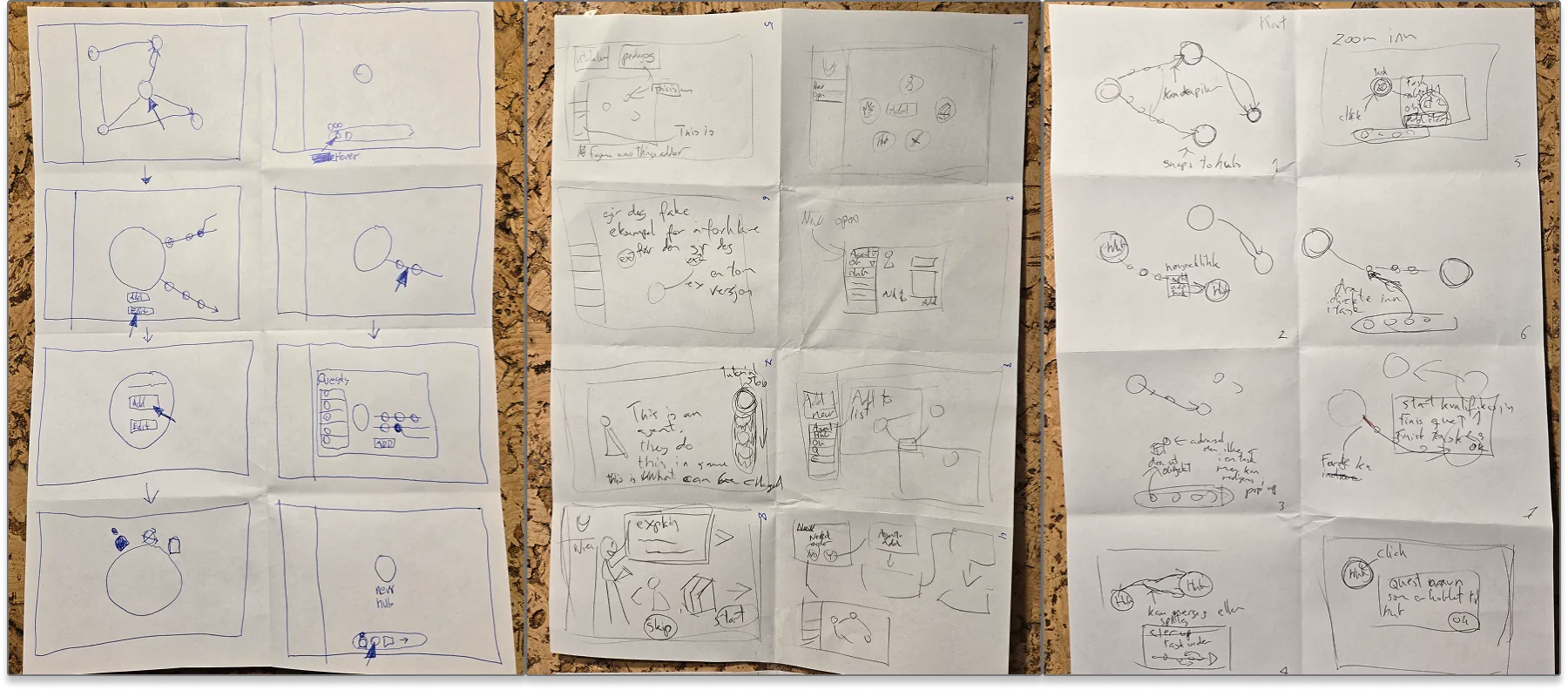
- Paper, then Figma, then code: Figma for the interface and the workshop flow, code for the map-based canvas.
- eLuna’s own palette: blocks and buttons told apart by shape, colour and function. A safe place to be wrong.
- Tested with five teacher students (Western Norway University of Applied Sciences), five information science students (University of Bergen), and SLATE.
Nova Luna Studio, in five parts
- Two ways in. Fully digital, or pen & paper first, so a teacher can run a workshop before anything is formalised.
- A collaborative canvas in eLuna’s visual language, for mapping stories, characters and challenges.
- XML/JSON export — the blueprint the developers build from.
- A demo game that updates as the developers push code, so classes can test it as it grows.
- A landing page with live notifications, project information and who is collaborating.
Get in toucholebrudvikjr@hotmail.com